

Belmont Council Gets New Member, Moves to Replace Meters
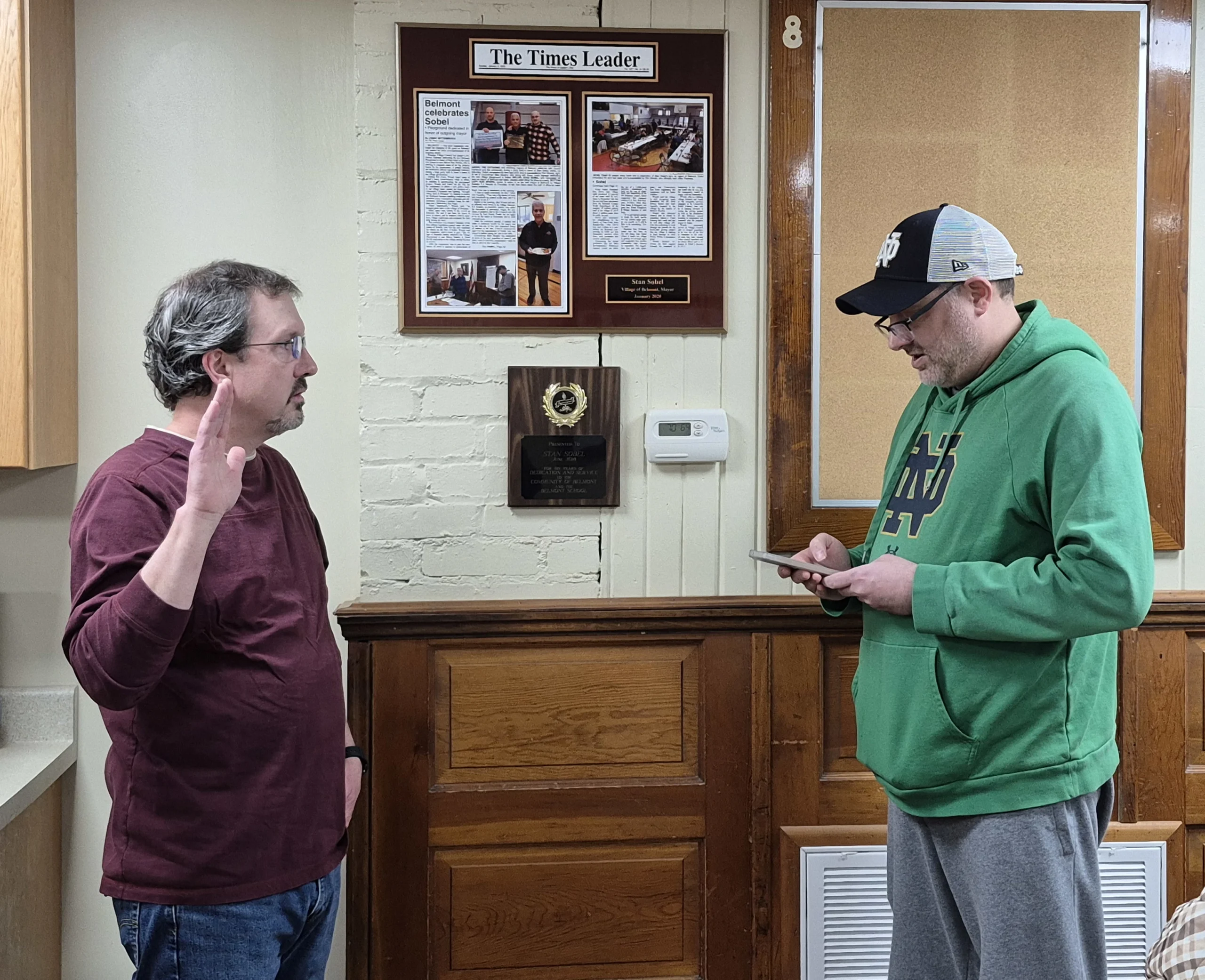
Belmont Village Council appointed a new member Wednesday and took initial steps to establish a water meter replacement plan.
Council’s first meeting of 2026 opened a few minutes after 6 p.m. with Solicitor T.J. Schultz immediately swearing in returning members. Council then approved the minutes of its December meeting and voted to enter executive session to discuss personnel.
Councilwoman Peggy Patterson abstained from that vote and did not join council behind closed doors because a relative of hers was one of two applicants for the vacant council seat. That position was left open in late 2025 when former councilwoman Sarah Scott moved outside village limits, making her ineligible to serve.
Council returned to regular session at 6:17 p.m., and Councilman Derek Cain – who had served as president in 2025 – announced that the personnel committee had received interest in the post from “two really, really good candidates.” He then called for a vote to appoint resident Lenny Wittenbrook as Scott’s replacement. That motion passed unanimously.
Schultz administered the oath of office to Wittenbrook, who then took his seat at the table.Council again voted to name Cain council president for 2026. He then announced that the finance committee recommended pay increases for village employees as follows:
Service Director Kerry Kemp from $18 to $19 an hour;
Street Crew Dan Schmitt from $17 to $18 an hour;
Street Crew Ken Orr from $16.50 to $17.50 an hour;
Schultz from $1,150 to $1,200 per month;
Gym Rental Assistant Nicholas Grob from $200 to $225 per month;
Water Clerk Jason Fowler from $475 to $505 a month; and
Fiscal Officer Ricky Burkhead from $1,550 to $1,600 per month.
Council voted to suspend the rules requiring three public readings of proposed legislation and then voted unanimously to approve the measure granting those pay hikes. Council members Wittenbrook, Patterson, Cain and Beverly Yoe voted in favor while Councilwoman Lori Grob abstained because Nicholas Grob is her son.
Burkhead then provided council with the fiscal officer’s report, noting that total appropriations for 2026 are set at $4,214,344.04. He stressed that the figure does not represent the village’s operating budget, which is much smaller, because more than half of that amount comes from state and federal grants for construction of a new firehouse. That work is well underway, with the steel frame of the new building already taking shape.
As part of his report, Burkhead mentioned that the rate the village pays Belmont County to purchase water is increasing by 3% for 2026 and that a lot of residential water meters have been failing recently, requiring replacement.
Ken Davis, president of the Board of Public Affairs, said one or two meters are being replaced each month and that the life expectancy of meters throughout the community is due to expire in 2027. Burkhead said the finance committee had met and discussed the need to replace meters throughout the village.
“We would like to allocate money to put in five meters a month,” he added, noting the new meters cost about $400 apiece.
In determining how to fund that work and cover the increased cost of purchasing county water, Burkhead recommended a rate increase.

“… The current water rate is 13.25 cents per 10 gallons,” he said. “We really need to add a penny to it to 14.25 and the exact same on the sewer side. It was 14.75 … I’m proposing it’s 15.75 (cents per 10 gallons). The big change is to add a once per month fee to the debt service charge of $7.”He said the $7 monthly fee would generate the $2,000 needed each month to replace five meters. The village has about 285 meters, and Burkhead said around 20 of them have already been replaced, leaving roughly 265 to install over several months.
Davis said the new meters will eliminate the need for village workers to drive around the community to receive meter readings. Instead, the new meters will send readings directly to the water department office. They also can alert water department staff of unusual usage patterns, allowing them to notify customers of potential leaks or other problems.
Burkhead said if the increased rates and additional fee are approved, bills for customers who use 1,000 gallons of water per month would increase by $9, while those who use 2,000 gallons would see an increase of $11 per month.
He also estimated it will take four and a half years to replace all of the meters in the village. The $7 fee would be eliminated after five years, once that work is completed.
“We need to work our way out of debt,” he added. “Unfortunately, with the sewer project that you did – and you had to do it – and it cost a lot of money.”
A community-wide sewerage system was installed prior to 2010, and the village is still paying on loans related to the project. Burkhead said the first of those is scheduled to be paid off in 2028. Related WesBanco bonds are scheduled for payment through 2034. Prior to that project, the community relied on septic systems, and some structures released raw sewage that was not treated before flowing into the ground or streams.
Council heard and approved the first reading of legislation that would increase water and sewer rates and add a $7 service fee as Burkhead recommended. The ordinance will have its second reading in February and, if approved by council, take effect immediately after its passage in March.
Council also voted to “loan” $13,000 from the General Fund to pay off bonds for past water tank repairs. Burkhead said paying those off now will save the village about $1,000 in interest.
In his report to council, Davis said the village is currently able to produce all of the water consumers use from its own well field, but the dry summer months saw the village purchasing as much as 70% of its water from the county. He added that the village wells are due to be tested for PFAS (aka “forever chemicals or Per- and Polyfluoroalkyl Substances). While village wells have never been found to contain PFAS, he said a positive finding could impact or eliminate the community’s ability to produce its own water and force it to buy exclusively from the county.
Davis added that 18 delinquent accounts had been paid and that residents are beginning to use a new service to pay their water bills with credit cards. He noted that cold weather brought two major leaks to the village with one home using an unexpected 6,000 gallons and another 13,000 gallons being leaked from a garage. He also thanked the village of Bethesda for loaning a camera that was used to inspect some waterlines.
Fire Chief Bob Mills said his department already responded to four fire calls and 12 emergency squad calls so far in 2026.
Council voted to pay bills and to authorize Mayor Ron Woods and Schultz to take any necessary action to dissolve the police department, which was idled after a proposed levy failed to receive voter approval in 2025.
Council also voted to meet at 6 p.m. the first Wednesday of each month with the next meeting scheduled for Feb. 4 in the Stanley Sobel Village Offices inside the gym at 209 Brown St.


Barnesville Area News Needs Your Support!
We're dedicated to providing coverage of the local happenings in Barnesville and the neighboring communities.
As a non-profit entity, we rely on the donations of readers like you.
Make a donation today and you'll be helping keep local news alive in the Barnesville area.